



























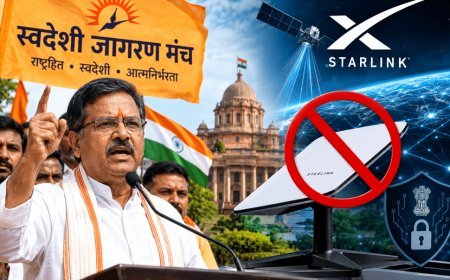





No compromise on national security! RSS-affiliated Swadeshi Jagran Manch demands suspension of Starlink services in India
It is a question of national security that any satellite internet provider has adequate technical arrangements to comply with the laws of India, lawful government directives and security related conditions. But it is also imperative that the restrictions are enforced under a clear legal basis, requirement and prescribed procedure. What is the government's position on Starlink? An important fact in this case is that Starlink has received the necessary license for satellite communication services in India. According to the information given by the Union Ministry of Communications in the Rajya Sabha on 29 January 2026, Starlink Satellite Communications Private Limited, OneWeb India Communications Private Limited and Jio Satellite Communications Limited were given license for satellite-based communication services. However, getting a license in itself is not the final permission to start commercial services. It also requires spectrum allocation and fulfilment of prescribed security and regulatory conditions. As per recent reports of October 2026, the government has clarified that the companies concerned will have to comply with the applicable regulations and safety requirements.
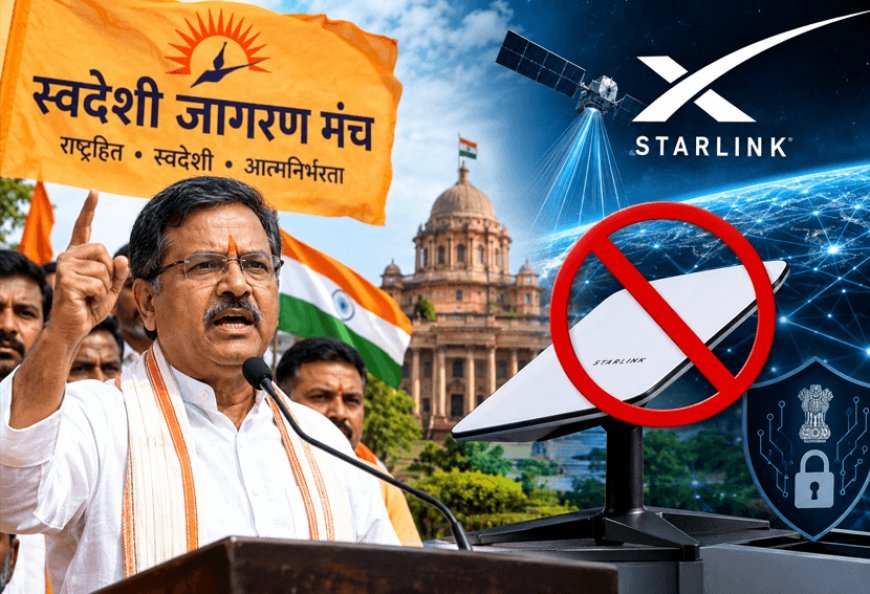
Questions about surveillance and data security on Elon Musk's satellite internet service; The challenge before the government is to balance national security and digital connectivity.
New Delhi. Elon Musk's SpaceX has been embroiled in a controversy over its satellite internet service Starlink. The Swadeshi Jagran Manch (SJM), an organisation affiliated to the Rashtriya Swayamsevak Sangh (RSS), has demanded that the central government not allow the company to start commercial services in India until concerns related to national security and telecom regulation are satisfactorily addressed. The organisation fears that satellite-based internet technology could make it challenging to monitor Indian internet traffic and control services in emergencies.
Questions on Internet Traffic and Surveillance System
According to Ashwani Mahajan, national co-convener of Swadeshi Jagran Manch, given Starlink's satellite technology and the arrangement of data communication between satellites in space, it is important to ensure that India's internet traffic operates in line with the country's security and regulatory framework.
The organisation argues that the government must ensure that security agencies have effective mechanisms to conduct surveillance as required under the law, cooperate in investigations and control telecom services in sensitive areas.
However, technical and regulatory evidence is required for a final conclusion on the extent to which Indian internet traffic can actually bypass Indian gateways and whether Starlink's existing technology is capable of meeting India's prescribed security conditions. The organisation's apprehensions cannot be presented as a certified security breach at the moment.
The ability to turn off the internet in an emergency is also an issue
Swadeshi Jagran Manch has said that in case of riots, terrorist activities, border tension or other serious law and order situation, the government should have the ability to impose temporary ban on internet services as per the need.
The organisation fears that satellite internet could be used as an alternative mode of communication in the restricted areas. It also referred to the alleged use of satellite internet devices in sensitive areas.
It is a question of national security that any satellite internet provider has adequate technical arrangements to comply with the laws of India, lawful government directives and security related conditions. But it is also imperative that the restrictions are enforced under a clear legal basis, requirement and prescribed procedure.
What is the government's position on Starlink?
An important fact in this case is that Starlink has received the necessary license for satellite communication services in India. According to the information given by the Union Ministry of Communications in the Rajya Sabha on 29 January 2026, Starlink Satellite Communications Private Limited, OneWeb India Communications Private Limited and Jio Satellite Communications Limited were given license for satellite-based communication services.
However, getting a license in itself is not the final permission to start commercial services. It also requires spectrum allocation and fulfilment of prescribed security and regulatory conditions. As per recent reports of October 2026, the government has clarified that the companies concerned will have to comply with the applicable regulations and safety requirements.
Therefore, it would not be correct to attribute Starlink's case only to the pendency of the licence application. The main question in the present situation is of the remaining clearances and conditions required for business operations.
Competition in the field of indigenous technology and telecommunications
Swadeshi Jagran Manch has also emphasized on strengthening India's domestic telecom capabilities. Referring to security-related objections raised earlier about Chinese companies Huawei and ZTE, it said India should increase self-reliance in strategic technologies.
However, the technical structure of satellite internet and traditional mobile networks is different. Therefore, a separate security assessment of each service is necessary instead of directly applying the decision made about one technology or company to another technology.
Satellite broadband can be useful in delivering internet to remote villages, hilly areas, border areas and places where expansion of fibre or mobile networks is difficult. The Government of India has also considered satellite communication services as a potential medium to enhance digital connectivity.
National security is paramount, but the decision is based on facts.
The objections to Starlink raise broader questions about India's digital sovereignty, data security and strategic control. It is important for the government to ensure that the same security standards are applied to any foreign or domestic satellite internet company and the rules are followed.
But the decision to impose a blanket ban on a company should not be based on mere apprehensions or political rhetoric, but on technical assessments, substantiated risks and existing laws.
The right path for India is to create a regulatory framework that encourages technological development, competition and better internet access to remote areas without compromising national security.
What's Your Reaction?