













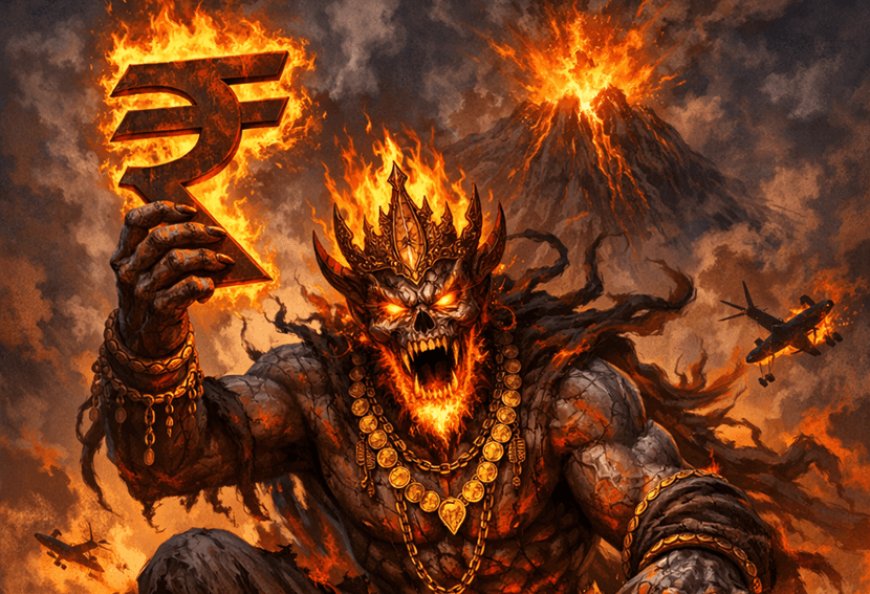
The demon of inflation will soon arrive in the country, far exceeding the government's stated intentions! India will have to pay the price of the Iran-US war with inflation!
India imports many items used in daily life from other countries. Therefore, there is a strong possibility of an unprecedented increase in inflation even after making changes in the items calculating inflation in the new base year and in the current scenario, it seems that inflation may cross the government-set limit of two percent more or two percent less in the coming months.
Despite Iran's ongoing conflict with the US-Israel, the government decided on March 25 that the inflation threshold would remain two percent higher or two percent lower than four percent. However, achieving this target in the current scenario will not be easy for the government and the Reserve Bank of India. However, this notification, i.e., the flexible inflation targeting (FIT) framework, will be effective from April 1, 2026, to March 31, 2031. This framework is reviewed every five years. Last time it was implemented from March 2021 to March 2026. India adopted the FIT framework in 2016 after amending the Reserve Bank of India Act, 1934. At present, 26 countries, including three developed ones, have adopted this system. In this concept, price stability is stated as the primary objective of monetary policy. Under this arrangement, the Monetary Policy Committee (MPC) was set up with three RBI officials and three external members to decide the interest rate of the monetary policy by a majority vote. The level of inflation depends on the balance of demand and supply. When people have more money, they buy more goods, which increases demand. If supply doesn't match demand, prices will go up. Conversely, when demand is low and supply is high, inflation falls. The prices of petrol, diesel, CNG and cooking gas are increasing in the country due to the increase in crude oil prices. The prices are likely to go up further as India imports a large part of its requirements from Russia, Iraq, Saudi Arabia, the US, the UAE, Qatar, Russia, Australia, etc. The government and the Reserve Bank have decided to maintain the set limit of inflation, assuming that the change in the base year will not put any pressure on this limit and it will remain at the set level. Since February 12, the government has changed the measurement base of inflation from 2012 to 2024. In the new base year, many old items have been removed due to their irrelevance, and new items have been added. At the same time, the weight of food items has been reduced and the weight of some non-food items, which usually have an impact on inflation, has been added. Therefore, it is believed that due to the prolonged war, inflation will remain intact at the level of two percent more or two percent less than the limit set by the government.
To measure inflation, the goods and services that contribute the most to its growth are chosen. These items are weighted in the Consumer Price Index (CPI) based on their importance. The National Statistical Office (NSO) calculates retail inflation every month from the CPI index, which includes goods and services that are used more in everyday life. Under the new base year, such goods and services have also been added, on which people are now spending more. For example, smartphones, internet, earphones, fitness bands, etc. OTT services like Netflix, Jio Hotstar, Prime Video, e-commerce platforms, air tickets, app-based taxi services, online services, shopping prices, and house rentals in rural areas are also now included in the index. Following the hike in international crude oil prices, the state-owned fuel retailer Nayara Energy has hiked petrol and diesel prices in India by Rs five per litre and Rs three per litre respectively. At the same time, hotels and restaurants are collecting LPG charges along with government tax from the customer. Although the government has banned it, there is no visible effect of this ban on the ground. The government has cut excise duty on petrol and diesel by Rs 10-10 per litre. The excise duty on petrol has been cut by Rs 13 per litre and on diesel by Rs 10 per litre. The price of crude oil in the international market has increased from 70 dollars to 110 dollars per barrel due to Iran's war with America and Israel. This is causing a loss of up to Rs 30 per litre to the oil companies. Usually, when the price of oil increases, the cost of transportation increases, as well as the price of goods.
India imports many items used in daily life from other countries. Therefore, there is a strong possibility of an unprecedented increase in inflation even after making changes in the items calculating inflation in the new base year and in the current scenario, it seems that inflation may cross the government-set limit of two percent more or two percent less in the coming months.
What's Your Reaction?