


























Nilekani's big bet on paper leaks: 'When paper is made, it is ready to be sold', will AI and digital exam system stop rigging?
After the 2024 NEET paper leak controversy, a high-level committee headed by former ISRO chief K. Radhakrishnan had given 101 recommendations to improve the examination system. These included suggestions on immediate, medium-term and broader institutional reforms. The credibility of any examination system is not built by technical measures alone. It also requires permanent leadership, trained staff, adequate budgets, clear responsibilities and independent oversight. How effective the new report will be should be judged more by its actual implementation than its recommendations. If the question paper is prepared on the day of the exam, the opportunity to steal or sell the already prepared final paper may be limited. If the process of printing and physical transportation is also removed, some of the traditional avenues of paper leakage may be closed.
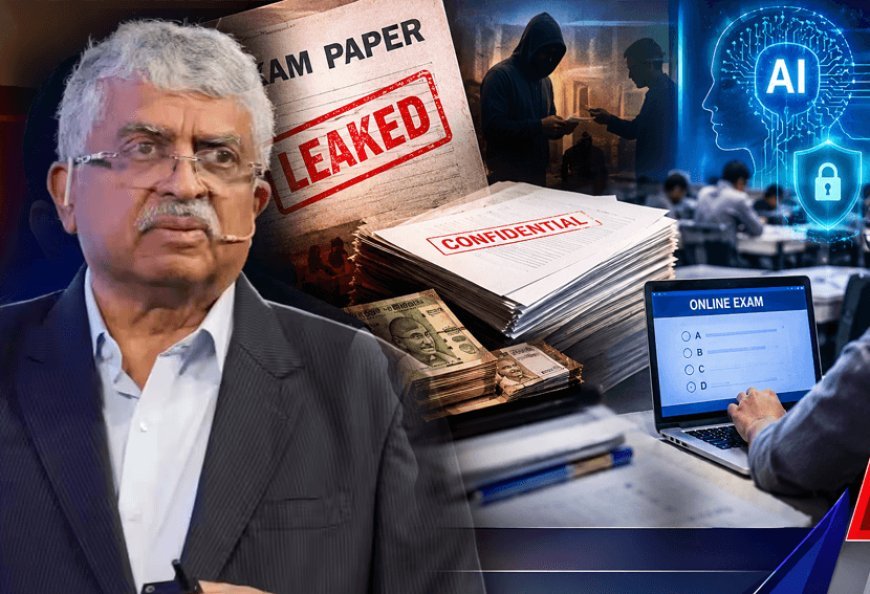
New Delhi: The problem of paper leaks in competitive examinations has raised serious questions about the future of lakhs of students, the credibility of the examination system and the accountability of government institutions. Every time there is a discussion of investigation, arrests and formation of new committees after paper leaks, but a permanent solution to the problem still remains a big challenge. In such a situation, a suggestion by Infosys co-founder Nandan Nilekani raises a new debate about changing the examination system. If the question paper is not prepared before the exam, how can it be leaked?
On 13 October 2026, at the Bloomberg New Economy Forum in New Delhi, Nilekani pointed to the hidden economic incentive behind the paper leak problem, saying that when a question paper is ready, it also creates the possibility of it being sold. His idea is not just limited to increasing the security of the question paper, but advocates changing the entire process in which the question paper is prepared, printed and reaches the examination centres.
But are digital technology and artificial intelligence aspects being considered?
The task force sought suggestions from students, parents, teachers, educational institutions and civic organisations. The first report is scheduled for October 28, 2026.
The importance of this initiative also increases because the impact of glitches in exams is not limited to just one exam or a few candidates. The hard work of lakhs of students, the financial investment of families and the trust in the selection process are linked to this.
'Don't make paper '- the real meaning of Nilekani's suggestion
Nilekani's proposal may seem unusual at first glance, but there is a clear technical rationale behind it. In the traditional system, the question paper is prepared before the examination. Then the process of securing it in a confidential manner, printing, packing and delivering it to the examination centres begins. Every person, place and medium involved in this entire chain can become a potential risk.
Nilekani wants to change the fundamentals of this process. Their idea can be explained in three main steps.
First, a huge digital question bank should be created. It may contain thousands or lakhs of questions subject-wise, course-wise and having different levels of difficulty. The quality and academic relevance of each question should be examined by experts.
Secondly, the question paper should be prepared on the day of the examination. The computer based system selects the questions from the question bank as per the prescribed rules and prepares a new question paper. AI can help, but clear rules and human oversight will be necessary for selection of questions, balancing of difficulty and final verification.
Thirdly, the confidentiality of the question paper and the delivery process should be made digital. This will reduce the risks associated with printing, physical transportation and distribution of question paper packets.
The basic idea of this model is that it should not be mandatory to prepare one final question paper much before the examination. However, this does not mean that information related to the question bank or digital system can never be leaked. The actual success will depend on how secure the question bank, server, access control and question paper preparation systems are.
The shift to CBT: Is India ready for this?
Nilekani mentioned about 1.5 lakh such centres in the country where computer-based examinations can be conducted. This number indicates the possibilities of expansion of the digital examination system. However, there may be a difference in the number of centres available and the actual capacity to successfully conduct examinations at a large scale.
Computer-based testing (CBT) has many advantages. The need for large-scale printing and physical distribution of question papers may be reduced. Separate sets of questions can be prepared for different candidates or exam centres. Arrangements like controlled digital access and time-bound delivery can also be adopted to maintain confidentiality of question papers.
But the challenge is that in big exams like NEET, lakhs of candidates have to take the exam in a limited time. This will require adequate computers, uninterrupted power supply, trained personnel, secure networks and alternate arrangements in case of technical glitches.
The availability of digital facilities in rural and remote areas is also not uniform. Therefore, merely increasing the number of centres will not be enough to make CBT a success. It is also important to ensure that every candidate gets equal opportunity and fair examination experience.
AI will stop paper leaks, but what about cyber attacks?
The idea of preparing the question paper with the help of AI is technically possible. However, AI by itself is not a guarantee of security. If there is unauthorized access to the question bank, there is a fault in the question selection system or an employee has more rights than required, then the digital system can also be messed up.
At least four security measures will be important in the new system:
Strong cyber security: Access to the question bank and the examination server should be limited and a secure record of every activity should be maintained.
Independent Audit: Check technical security, question selection and data access before and after the exam.
Control of the quality of the questions: The difficulty level of different papers students get different questions, so how will their marks be compared. For this, the difficulty of the questions and the reliability of the assessment have to be ensured. With the big question bank this task becomes not easier, but more important.
So the real goal should not be just to create digital question papers. The goal should be to create a system in which paper leaks are difficult, malpractices are detected and accountability is fixed on any irregularity.
If the old 101 recommendations were not implemented, what will the new report change?
The biggest challenge before the Nilekani task force's proposals is not the technology, but their implementation.
After the 2024 NEET paper leak controversy, a high-level committee headed by former ISRO chief K. Radhakrishnan had given 101 recommendations to improve the examination system. These included suggestions on immediate, medium-term and broader institutional reforms. The credibility of any examination system is not built by technical measures alone. It also requires permanent leadership, trained staff, adequate budgets, clear responsibilities and independent oversight. How effective the new report will be should be judged more by its actual implementation than its recommendations. If the question paper is prepared on the day of the exam, the opportunity to steal or sell the already prepared final paper may be limited. If the process of printing and physical transportation is also removed, some of the traditional avenues of paper leakage may be closed.
But the danger is not completely averted. There is a possibility of questions being stolen from the question bank, a breach in the examination system, internal collusion, technical glitches or irregularities at the examination centres.
Technology, therefore, has to be an ally and not a substitute for institutional reforms.
Conclusion: No Committees, Trusted System Needed
Nilekani's proposal gives an important direction to the examination reform debate. It does not only raise the question of keeping the paper safe, but talks about changing the system in which the question paper is prepared in advance and goes through several stages.
But it's not enough to just reassure students of new technology. They want an examination system in which the question paper is not leaked, the examination is not affected by technical glitches, all candidates get equal opportunity and timely action is taken against those responsible in case of a glitch.
For this, the institutional framework of NTA has to be strengthened with investments in digital question banks, CBT networks and cyber security. The status of the old recommendations will have to be made public and the timeline for implementation of the new recommendations will also have to be fixed.
After all, the real test of stopping paper leaks will not be the Nilekani report, but the will of the government and examination agencies to implement it. Technology can help make the question paper safer, but the trust of students in the system will return only when safety, transparency and accountability are visible simultaneously.
What's Your Reaction?