
































Meerut Blue Drum Massacre: Court sentences Muskan, Sahil to death for killing husband
The court, while sentencing the two after convicting them, gave importance to the seriousness of the crime. During the verdict, it was also said in the context of Mahabharata that punishing the criminal according to his crime is an act of religion. This comment has created a wider discourse on justice, morality and the purpose of punishment.

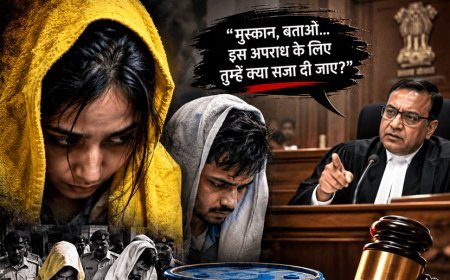
Meerut. A court in Uttar Pradesh has awarded death sentence to Bollywood actor Saurabh Rajput's wife Muskan Rastogi and her paramour Sahil in connection with the brutal murder of her husband. The two convicts, who appeared through video conferencing from the district jail, were awarded the punishment by the court in view of the gravity of the offence. Separate fines were also imposed on them. The case has once again raised serious questions on the crimes that have shaken the society, the crisis of trust in human relationships and the role of the justice system.
The horror of this murder was not limited to murder. According to the allegation, after the murder of Saurabh Rajput, his body was hidden in a blue drum. The incident inside the house also disturbed the people because the people associated with the relationship in which security, trust and lifelong companionship are expected, were accused of this heinous crime.
Judgment of the court and the message of justice
The court, while sentencing the two after convicting them, gave importance to the seriousness of the crime. During the verdict, it was also said in the context of Mahabharata that punishing the criminal according to his crime is an act of religion. This comment has created a wider discourse on justice, morality and the purpose of punishment.
However, the real significance of a sentence in any case is not determined by its harshness alone, but by ensuring fair trial, cogent evidence and justice in consonance with law. For the family of the deceased, this verdict is an important milestone towards justice after a long wait, while for the society, it is a reminder that along with prevention of crime, it is also necessary to maintain faith in the judicial process.
13 months of hearings, 126 dates and witness statements
On September 30, the court had convicted Muskan Rastogi and Sahil and fixed October 14 for pronouncing the quantum of sentence. As per the details available, statements of more than 22 witnesses were recorded during 126 dates in the judicial process that lasted for about 13 months after the trial began in July 2025.
Such long hearings also show how crucial the examination of evidence, witnesses and legal arguments are in serious criminal cases. Delay in justice can prolong the agony of the victim's family, but it is equally important to ensure a fair and evidence-based trial with the expectation of an early verdict.
Saurabh's family had demanded the strictest punishment.
Saurabh Rajput's family had asked the court to award capital punishment to the two convicts. His brother Rahul had said that the family had hoped for justice from the beginning and wanted punishment commensurate with what had happened to his brother.
For a family to lose a loved one in this way is not just a personal loss, but a grief that will last a lifetime. The judicial verdict in such cases cannot end the agony of the victim's family but can assure them that the crime was tried within the ambit of law and the culprits were held accountable.
Will stricter punishment deter crime?
A debate on the issue is raging in the country. However, it is too early to say that one decision will completely stop such crimes in the future. Effective implementation of law for prevention of crime, timely investigation, preservation of evidence, strengthening of judicial process and clear rejection of violence in society - all these have a role to play.
Capital punishment is the harshest punishment in India and it is given in extremely limited circumstances under the law. Therefore, in a case, it should be determined not merely on the basis of public sentiment, but on the basis of facts of the crime, available evidence and applicable legal principles.
Crisis of trust in relationships and questions facing society
The Blue Drum massacre has once again raised the question of how disputes in personal relationships can lead to serious violence. But it would also not be appropriate to confine the incident to a matrimonial or personal dispute. Under no circumstances can murder be justified, nor can conclusions be drawn about the whole of society or any class on the basis of a single incident.
The biggest learning from this case is that justice is not just the name of sentencing. Justice means fair investigation of facts, punishment in accordance with law on conviction and the victim's family trust in the judicial process.
The blue drum massacre of Meerut will be remembered for a long time because of its horrors. The court's verdict has taken an important step towards fixing accountability of the convicts. Now the focus of society's serious response to this incident should not only be the demand for severe punishment, but also the prevention of such violent incidents, respect for the law and the preservation of trust in human relationships.
What's Your Reaction?