












Delhi's air pollution: Investigation of 2,011 industrial units, 106 found in violation of rules; Government's message - 'No more leniency on pollution'
The Delhi government has talked about strengthening the surveillance system, technology-based monitoring, coordination among government agencies and citizen participation. But at the political and social level, the success of this campaign will not be judged only on the basis of how many units were fined or how many closure orders were issued. The real question will be, do these actions lead to a permanent reduction in pollution levels? Are there regular inspections of industries that break the rules? Are the rules uniformly followed from small traders to large industrial establishments? And will the common Delhiite be able to feel a real improvement in its air in the coming months?
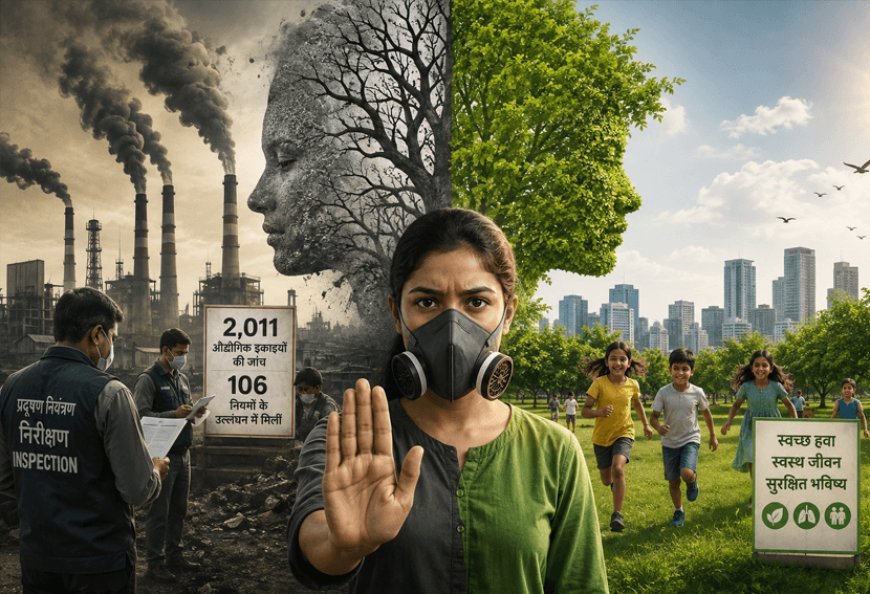
New Delhi: Amid concerns over Delhi's toxic air, the Delhi government has claimed to be strict on industrial pollution. The Delhi government, led by Chief Minister Rekha Gupta, says action on clean air will no longer be limited to announcements, but will be a direct crackdown on sources of pollution. Between January and July 2026, the government inspected 2,011 industrial units, out of which 106 units were found not complying with the prescribed environmental standards.
Most seriously, 78 industrial units were found to be operating without valid Consent to Operate (CTO) of the Delhi Pollution Control Committee (DPCC). The government has initiated action in the matter. Environmental compensation was imposed in 44 cases, while closure orders have been issued against 33 non-compliant units.
Beyond action, the political message is clear.
Pollution in Delhi has long been a major topic of political debate and not just an environmental issue. With air quality worsening every winter, governments have been questioned about how effective control is being exercised over the actual sources of pollution. In such a situation, by putting forward the data of action on industrial units, the Delhi government is trying to send a message that its strategy is not limited only to rhetoric on pollution.
Chief Minister Rekha Gupta said that the government will provide support to industries complying with environmental rules, but strict action will be taken against those who are damaging Delhi's air by breaking the rules. In this attitude of the government, along with administrative action, the political message is also visible - On the issue of pollution, the government wants to move on the path of fixing responsibility and putting out a record of action.
The question is not only of the factories, but of the entire air of Delhi
However, Delhi's pollution is not just caused by industrial units. Road dust, vehicular fumes, construction and demolition, open burning of garbage and other polluting activities also affect the capital's air quality. Therefore, the government's campaign is talking about action on all these sources, going beyond industrial pollution.
This is also the biggest social challenge of this campaign. For the common citizen of Delhi, pollution is not an issue of victory or defeat for any political party, but a question of everyday life, health and quality of life in the city. So the real test for the government will be how much the data on inspections and fines can make a difference to clean air on the ground.
People are also being made part of the surveillance.
The government has also appealed to citizens to report polluting activities. Complaints of industrial pollution, open burning of garbage or other material, dust, illegal dumping of garbage and activities causing damage to the environment can be made through the Green Delhi App or MCD 311 App.
This initiative is important in terms of social participation as it is not easy to monitor every polluting activity in a large metropolis like Delhi with the help of government monitoring mechanism alone. If the grievance mechanism remains effective and accountable, citizens can directly become part of the monitoring mechanism.
The real test: Changes in data
The Delhi government has talked about strengthening the surveillance system, technology-based monitoring, coordination among government agencies and citizen participation. But at the political and social level, the success of this campaign will not be judged only on the basis of how many units were fined or how many closure orders were issued.
The real question will be, do these actions lead to a permanent reduction in pollution levels? Are there regular inspections of industries that break the rules? Are the rules uniformly followed from small traders to large industrial establishments? And will the common Delhiite be able to feel a real improvement in its air in the coming months?
At the moment, the government's message is clear - action will continue against industries that play with Delhi's air. But the biggest challenge before the government will be to convert this strictness into a sustainable environmental policy beyond political assertion. Because the people of Delhi now want concrete results of breathable air, not just news of action.
What's Your Reaction?