










The 80-year journey: India's population to more than quadruple from 34 crore at the time of independence to 147 crore in 2026
As a result, the country's population grew rapidly. By 1981, India's population increased to about 68.3 crore. That is, the population of the country almost doubled in just three decades. The fastest growth in population between 1951 and 1981 Between 1951 and 1981, India's population growth was very rapid. At that time the birth rate was quite high, while the death rate steadily declined due to improvements in health services, sanitation and medical facilities. This had a direct impact on population growth. India's decadal population growth rate of about 24.8 percent during the decade 1961-1971 is counted among the highest growth rates in the country's history.
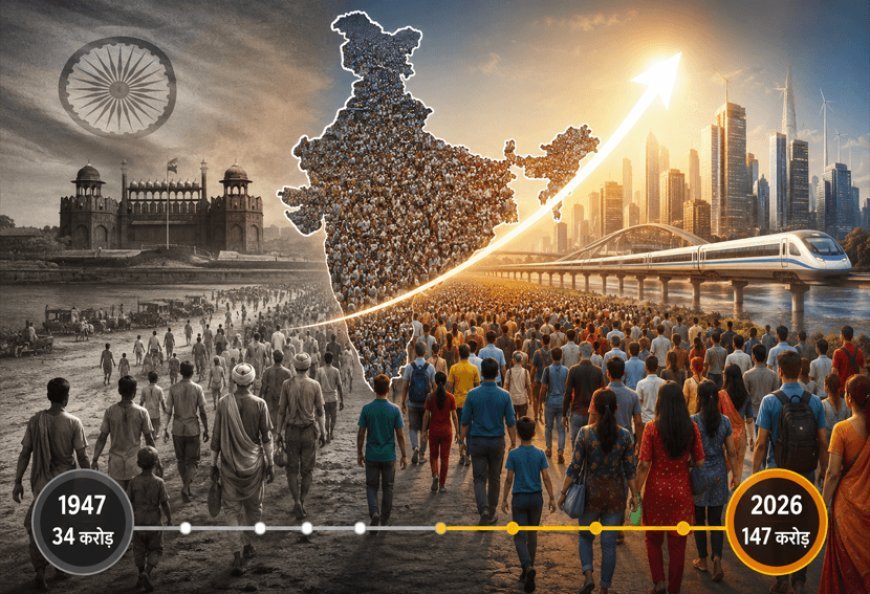
New Delhi: India is going to celebrate the 80th anniversary of its independence this year. Since independence from British rule on 15 August 1947, the country has come a long way in the social, economic and technological fields. While at the time of independence, India faced serious challenges like partition, poverty, hunger and limited resources, today India is among the most populous countries in the world.
What was the population of India at the time of independence?
At the time of India's independence, i.e. in 1947, the population of the country was about 34 crore (340 million). In the first census after independence i.e. in 1951, the population of India was recorded to be about 36.1 crore.
As a result, the country's population grew rapidly. By 1981, India's population increased to about 68.3 crore. That is, the population of the country almost doubled in just three decades.
The fastest growth in population between 1951 and 1981
Between 1951 and 1981, India's population growth was very rapid. At that time the birth rate was quite high, while the death rate steadily declined due to improvements in health services, sanitation and medical facilities. This had a direct impact on population growth.
India's decadal population growth rate of about 24.8 percent during the decade 1961-1971 is counted among the highest growth rates in the country's history.
100 crore in 2001.
After 1981, India's population growth rate gradually declined, but the population base had become so large that the total number continued to grow.
In 2001, India's population crossed the 1 billion mark. After this, in the 2011 census, the population of the country was recorded at about 121 crore. However, the decadal population growth rate declined to 17.7 per cent during this period.
More than 147 crore population in 2026
The projected population of India in 2026 is now estimated to be around 147.66 crore. That is, the population of the country has more than quadrupled from about 34 crore in 1947.
With this huge expansion of population, India faces challenges like employment, education, health, housing, food security and pressure on natural resources. At the same time, a large population also presents huge human resource and market opportunity for India.
The journey from 1947 to 2026 is not just the story of population growth, but the whole picture of changing India. From 34 crore to about 148 crore, the country is now deciding its new role as the nation with the largest population in the world.
What's Your Reaction?