





















The Price of Freedom: The line drawn in five weeks, which changed the fate of millions
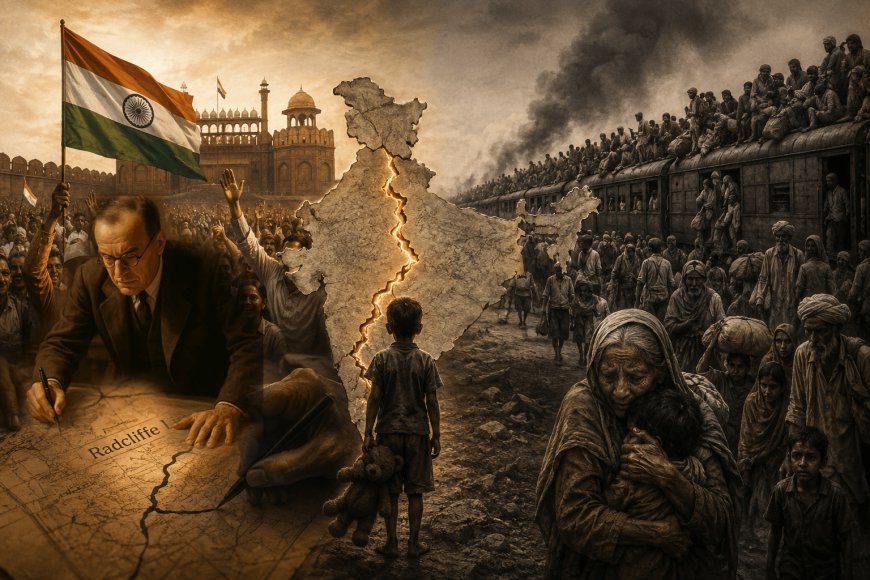
The Radcliffe Line wasn't just a boundary drawn on a map. It cut across villages, fields, roads, railway lines, rivers and markets. In many places, this boundary was also drawn between families and communities. About 1.4 crore people are estimated to have been displaced during the Partition. Historians differ on the number of deaths, but different estimates range from several lakhs to nearly 20 lakhs. Massive riots broke out in Punjab. Lakhs of people belonging to Hindu, Muslim and Sikh communities were displaced from their homes. Bengal also witnessed large-scale displacement, the effects of which were visible for decades to come. The Radcliffe Line is still alive after 80 years
New Delhi. India is celebrating its 80th Independence Day. From the tricolor to schools and TV studios, the stories of the freedom struggle are being retold. The midnight of 15 August 1947, the historic speech of independence and the tricolor hoisted at the Red Fort are among the most glorious images in Indian history. But there is also a tragedy associated with this freedom, the price of which millions of families lost their homes, land and loved ones. This is the story of the partition of India-Pakistan and the boundary line that changed not only the geography of the subcontinent but also the future of millions of people.
At the centre of this story was Sir Cyril John Radcliffe, a British lawyer who had never even visited India before 1947. Yet he was entrusted with the task of demarcating the boundary dividing British India into India and Pakistan. Their border was historically known as the Radcliffe Line.
Who was Sir Cyril Radcliffe?
Cyril John Radcliffe was born in Wales in 1899. After graduating from Oxford University, he studied law in London. During the Second World War, he also held important administrative responsibilities with the British government.
But the biggest reason why he was entrusted with one of India's most difficult and controversial responsibilities in 1947 was that he had no old political or personal connection with India. The British government hoped that by staying away from Indian politics, they would be able to give a fair verdict.
Ironically, the man who had never seen India before had to draw the line that would define the lives and future of millions.
Why did Britain need Radcliffe?
In 1947, Britain expedited the process of transfer of power from India. Lord Mountbatten had announced that British rule would end in August. The political decision to divide India had been made, but the biggest question still remained - where would the border of India and Pakistan finally be?
The most difficult situation was in Punjab and Bengal. Hindus, Muslims and Sikhs lived in harmony in the two provinces. It was almost impossible to draw such a boundary on the basis of religion alone, which would be acceptable to every community.
Separate boundary commissions were set up for Punjab and Bengal. Radcliffe was made chairman of both commissions. When the members of the commission could not agree on an issue, the responsibility for the final decision fell on Radcliffe.
Only five weeks and the future of millions of people was in front.
Radcliffe arrived in India on 8 July 1947. They had about five weeks to set the limit. In this short period, he had to study census data, district boundaries, canal and irrigation systems, railway networks, administrative connectivity and political claims of both sides.
In Punjab, the situation is more complicated. The religious and economic roots of the Sikh community were spread across many regions. It was not easy to divide the canals and irrigation system between the border. Railway lines also connected cities and regions that were suddenly going to be part of different countries.
The situation in Bengal is very bad. There was a bitter dispute over the future of Calcutta and the whole province was economically and socially bound together.
The most shocking thing - the border was announced after independence
India and Pakistan were born in August 1947. But it was not clear to the general public where the final border would pass.
The Radcliffe Award was made public on 17 August 1947, two days after India's independence.
This meant that many families saw the sun of independence, but did not know whether their village, farm, city or house would eventually remain in India or Pakistan.
After the announcement of the border, the situation changed rapidly. People have left their houses. There were huge crowds on the roads and railway stations. Families were separated and a large number of people suddenly had to become refugees.
Not one line, but millions of lives
The Radcliffe Line wasn't just a boundary drawn on a map. It cut across villages, fields, roads, railway lines, rivers and markets. In many places, this boundary was also drawn between families and communities.
About 1.4 crore people are estimated to have been displaced during the Partition. Historians differ on the number of deaths, but different estimates range from several lakhs to nearly 20 lakhs.
Massive riots broke out in Punjab. Lakhs of people belonging to Hindu, Muslim and Sikh communities were displaced from their homes. Bengal also witnessed large-scale displacement, the effects of which were visible for decades to come.
The Radcliffe Line is still alive after 80 years
This border drawn in 1947 still has a profound impact on the politics and security system of South Asia. From India-Pakistan relations to border security, movement of people, Kashmir dispute and water related questions, the legacy of Partition exists even today.
So remembering the Radcliffe Line on India's 80th Independence Day is not just remembering the past. It is also to understand the paradox in which on the one hand India was celebrating independence and on the other hand millions of people had gone out on unknown paths to save their homes, families and identity.
15 August 1947 gave India independence, but a boundary line that came out on 17 August left such a mark on the history of the subcontinent, whose effect has not ended even after 80 years.
What's Your Reaction?