








Headline - Media has to understand the movement of youth on Jantar! Let go of arrogance and flattery, now the media is needed The Message of Self-Realization: The media needs to introspect now.
Rising above arrogance, power-devotion and sensationalism, journalism has to win the trust of the people again.
Rising above arrogance, power-devotion and sensationalism, journalism has to win the trust of the people again.
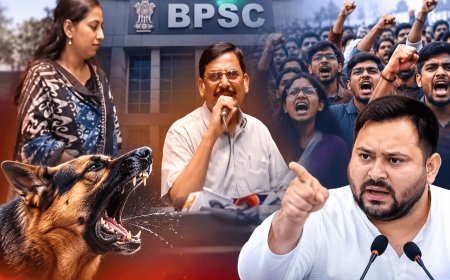
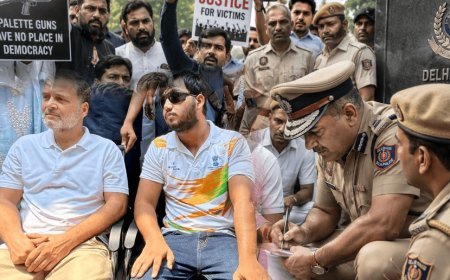
The agitation by students and youth at Delhi's Jantar Mantar was not limited to the resignation of a minister. The movement became a symbol of serious questions raised on the country's democracy, education system and above all, the credibility of the media. The movement may be over, but the voices raised during it will continue to shake Indian democracy and journalism for a long time.
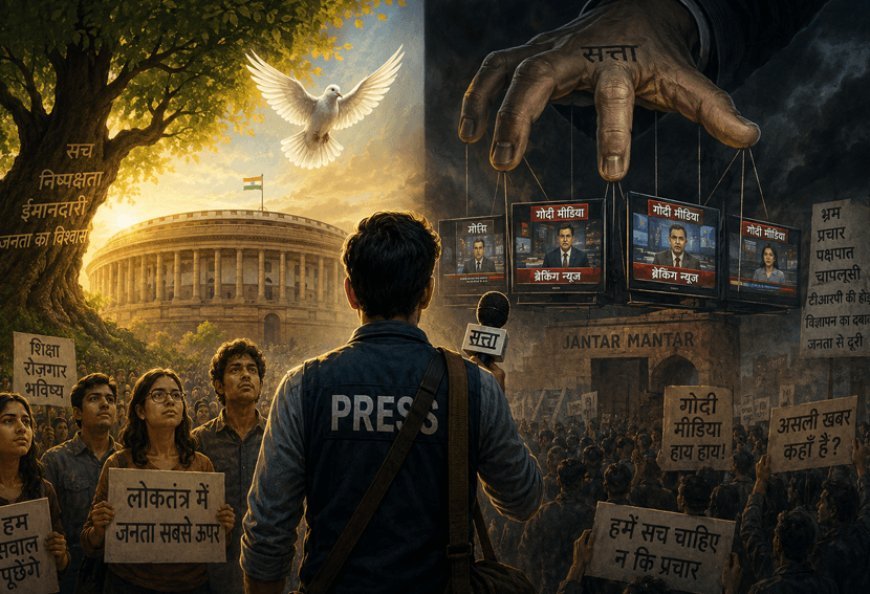
The most important aspect of this movement was that a large number of youth expressed their deep dissatisfaction with the mainstream media. This discontent was not limited to a single channel or journalist, but against a journalism that has been constantly accused of standing up for power, ignoring public servants and avoiding uncomfortable questions.
Undoubtedly, physical assault on any journalist is against democratic values and cannot be condoned. The safety of journalists is as important as freedom of expression. But the message behind the incident cannot be ignored. If a large section of the society starts losing faith in the media, it becomes a crisis not only for the media but for the entire democracy.
The basic purpose of journalism is not to propagate power, but to question power. In a democracy, the media is called the fourth pillar because its role is that of an impartial watchdog between the people and the government. When the media stops asking tough questions of power and starts spreading only its achievements, its credibility starts weakening gradually.
The history of Indian journalism has been associated with public service, freedom and social responsibility. During the freedom movement, newspapers were more a part of a mass movement than a business entity. His aim was to make the society aware and raise voice against injustice. Over time, media expanded, technology changed, and business grew, but at the same time, markets, advertising, and political influence influenced journalistic priorities.
The biggest challenge before the media today is its credibility. Viewers and readers want news, but not biased or incomplete information. When an important mass movement does not get enough space in the initial days and later the same event becomes a national debate, then questions naturally arise whether the selection of news is being done on the basis of journalism or due to any other pressure.
Commercial competition, TRP jostling, political polarisation and increasing reliance on government advertisements have also impacted media freedom. Doing fair journalism in such an environment is certainly difficult, but not impossible. Even today, many journalists are doing fact-based, courageous and pro-people reporting despite limited resources. It is journalism that preserves the faith of the society.
The growing popularity of digital media and independent journalists is also a sign of this change. People are no longer dependent only on big channels. They want to investigate the truth themselves by taking information from many sources. This does not mean that the need for traditional media is gone, but that it has to seriously consider the way it works.
The media has to understand that its biggest asset is not government advertisements, TRPs or political proximity, but public trust. If this trust is lost once, it will be very difficult to regain it. the reputation of journalism is formed not only by large studios, bright graphics or high-pitched debates; It is made up of facts, fairness, honesty and courage.
The movement of Jantar Mantar is both a warning and an opportunity for the media. The warning is because people are now asking questions. Opportunity because there is still time to improve your direction. If the media rises above power, market and ideological compulsions and places its accountability to the public at the top, it can regain lost trust.
A strong and independent press is as essential as a strong government in a democracy. Therefore, what is most needed today is not an argument, a defence or an accusation, but introspection. The future of journalism will be secured on the day when the media will again consider guarding the truth, not power, as its biggest religion.
What's Your Reaction?